Mara opened the envelope on the morning of January 6, at the kitchen table, while I stood at the counter pretending to care about the coffee. She asked me to go ahead and leave for the job site. I said I would stay in the next room if she wanted, and she nodded, and I took my mug to the living room and did not turn on the television.
She read it alone for about twenty minutes. I know because I watched the clock over the bookshelf more than I should have. When she came to the doorway, the pages were folded in her hand, and her eyes were red but steady. 'I read it,' she said. 'I want you to read it too. Not because you need to fix anything. Because I don't want to carry it by myself.'
I did not know what she had read before that moment, or whether she had left anything out, and I did not ask. That was hers to tell. She handed me the pages, and I sat down on the arm of the couch.
The letter was dated 2013, in Amos Bellamy's blocky handwriting, two pages on lined paper. He wrote that he had two grandchildren who were nothing alike. One of them, he said, tended to ask for things loudly, and the other tended to wait until she was sure she'd be forgiven for asking. He wrote that he did not want either of them to be treated as the easy one or the hard one when he was gone. If one seemed to need more help in a given year, he wrote, that was a reason to help, not a reason for the other to disappear from the family's attention.
Near the end he wrote, 'I want you both counted. Nobody should have to earn a seat at the table I've set.' I read that line twice. Then I handed the pages back, because my hands needed something else to do.
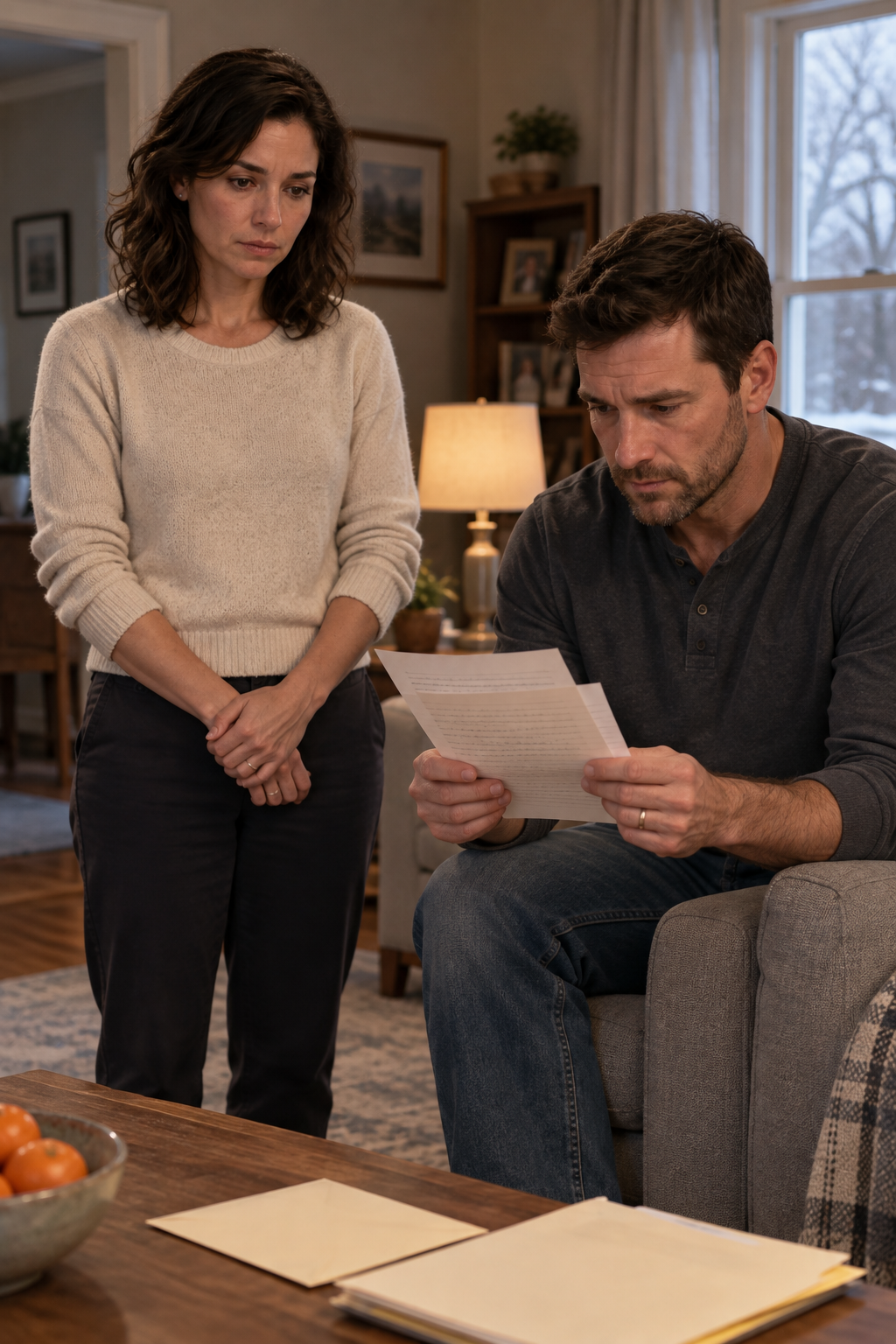
'He knew,' Mara said. 'Not about the graduation. Not any of it. But he knew how it would go.' She sat down across from me and pressed the folded letter flat against her knee. 'And I keep thinking, why does that make me want to cry and also feel guilty?'
'Guilty how?'
'Like I'm using a dead man's handwriting to ask for something.' She gave a short, dry laugh. 'Even now, I hear my mother saying it. Selfish.'
I said nothing clever. I said that asking to be counted was not the same as taking from someone, and that she could be sad and entitled to an accounting at the same time. She looked at me for a moment, and I thought she might push back, but she only nodded slowly.
That afternoon she called Celia Navarro, and this time she put the phone on the table and asked me to stay. She read parts of the letter aloud. Celia listened without interrupting, and then she was careful in a way I had come to respect.
'It's meaningful,' Celia said. 'It may help explain what your grandfather intended and how he saw the two of you. But I want to be clear about what it is. The trust instrument controls your interest. That document is what gives you an equal beneficial share. This letter doesn't amend it, and I wouldn't tell you it changes your rights by itself.'
'So it doesn't help?' Mara asked.
'It helps as context. It can support the point that equal treatment was the purpose, which is useful in a negotiation. It isn't a command anyone is bound to follow, and it doesn't tell us what any earlier payment was, or how it should be counted. The records do that work.' She paused. 'I'd rather you hear it from me now than build your hopes on a page that can't carry them.'
Mara was quiet. I expected disappointment. Instead she breathed out and sat back, as if a weight she had been bracing against had just been named and measured.
'Okay,' she said. 'Then what I want from the meeting is simple.' She counted it off on her fingers. 'First, complete records, and a way for us to check them. Second, the share the trust gives me, on the terms the document actually states. Third, I don't use Nolan's trouble to get anything. I won't hold the loan or the failed investment over him like a club. I just want it all counted honestly.'
'Do you want to say that to them?' I asked.
'I want Celia to say it. And I want to be in the room.' She looked at me, and I understood the rest before she said it. 'You're not.'
'I know,' I said, and found that I meant it.
She wrote the three points on an index card in her own handwriting and slipped it into the front of the accordion file, beside Amos's letter. Celia confirmed the meeting for the fifteenth, with an agenda sent ahead of time. It was a meeting with specific business, not an invitation to give in. When Mara hung up, she did not ask me whether she was being unreasonable. She went to the sink, rinsed my cold mug, and set it in the rack.